 Contact us
 RPEQ sign in
 RPEQ directory

Become a RPEQ
On this page
What is a RPEQ and why is registration required?
If you are providing professional engineering services in or for Queensland, you are required by Queensland law to register as a Registered Professional Engineer of Queensland (RPEQ), unless you are working under the direct supervision of a RPEQ or working to a prescriptive standard.
Holding RPEQ registration demonstrates your qualifications, experience and competency have been independently assessed and recognised.
For almost a century, RPEQ registration has represented professional engineering expertise, competence, and accountability in Queensland engineering.
RPEQ history and background
In 1930, Queensland Government passed the Professional Engineers Act (Qld) (PE Act) to regulate professional engineering services in and for Queensland. According to the PE Act, only qualified and competent persons who have gained registration may carry out professional engineering services in and for Queensland
University of Queensland Professor and engineer Roger Hawken was the driving force behind the legislation. Professor Hawken sought to:
protect the public by ensuring professional engineering services are provided by a registered professional engineer in a competent way,
maintain public confidence in the standard of services provided by registered professional engineers, and
uphold the standard of practice of registered professional engineers.
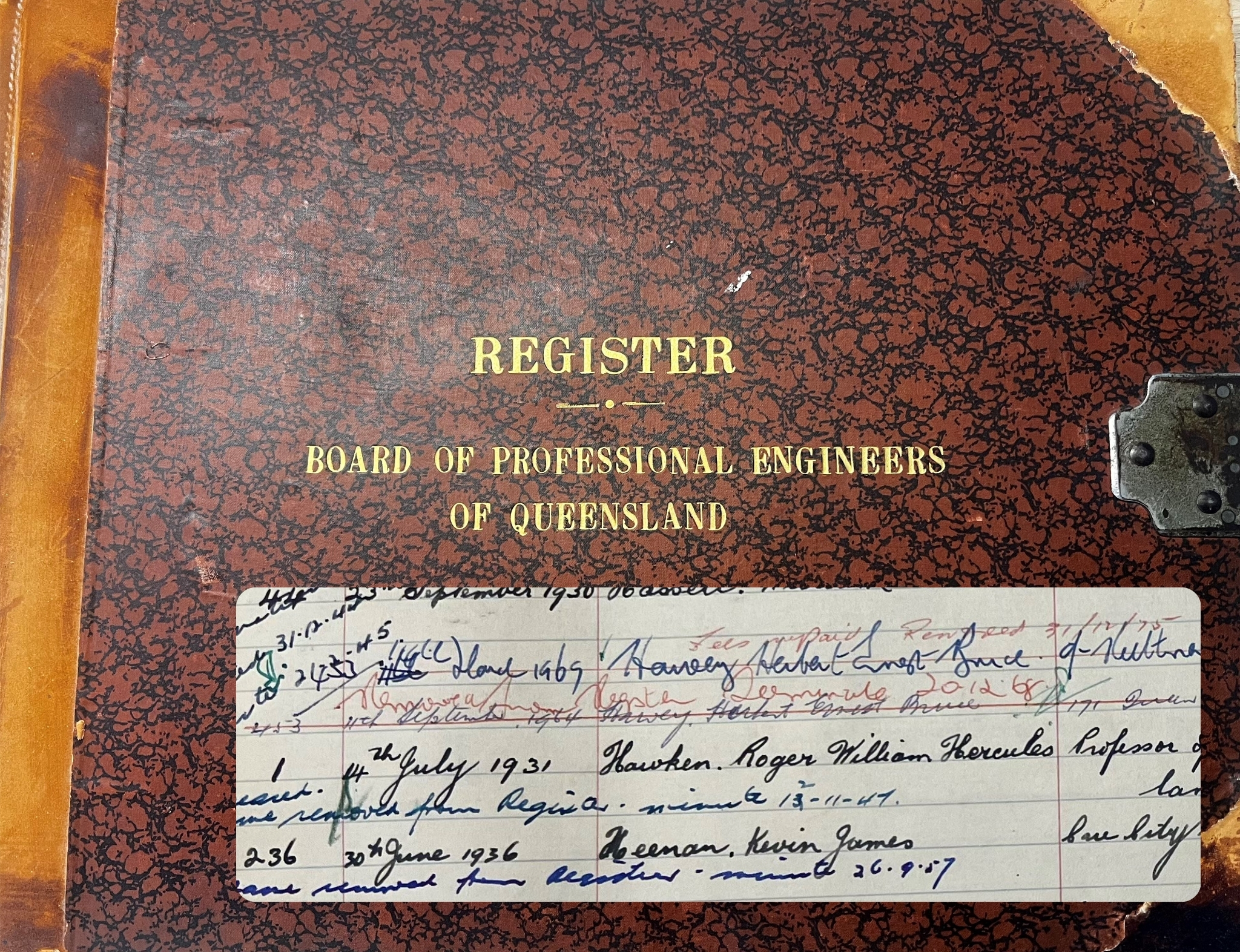
Pictured above, original RPEQ Register, with information on Roger Hawken, RPEQ #1
Through Professor Hawken’s vision and action by Queensland Government, the Board of Professional Engineers of Queensland (BPEQ) was established to fulfil these objectives, and the RPEQ system was born.
Nearly 100 years ago, Professor Roger Hawken became RPEQ #1. Today, more than 37,000 engineers have held the legally protected title of RPEQ.
Understanding your legal obligations
The Professional Engineers Act (Qld) (PE Act) and accompanying regulations set out BPEQ’s functions and laws relating to the practise of professional engineering services in or for Queensland.
Any person providing professional engineering services in an approved area of engineering in Queensland or for Queensland must:
Be registered as a RPEQ, or
Only work under the direct supervision of a RPEQ, or
Only work to a prescriptive standard.
Where the law applies
The law applies to professional engineering services provided in Queensland and for Queensland. The PE Act applies in the following scenarios:
Scenario one - If you are providing professional engineering services in Queensland for Queensland.
Example: You are a geotechnical (mining) engineer based in Toowoomba working on a project for a mining site near Gladstone, the PE Act applies.
Scenario two - If you are providing professional engineering services in Queensland for anywhere else in the world.
Example: You are a structural engineer in Brisbane working on a high-rise apartment building in Sydney, the PE Act applies.
Scenario three - If you are providing professional engineering services for Queensland and are based anywhere else in the world.
Example: You are a civil engineer based in Singapore working for a multi-national company on a highway upgrade outside of Cairns, the PE Act applies.
The examples above are hypothetical and are intended solely to demonstrate how the principles discussed may apply in practice.
What is a professional engineering service?
"an engineering service that requires, or is based on, the application of engineering principles and data to a design, or to a construction, production, operation or maintenance activity, relating to engineering, and does not include an engineering service that is provided only in accordance with a prescriptive standard."
Areas of engineering
The Board currently registers engineers in 19 areas of engineering. A full list of areas of engineering the Board registers can be found at the link below.
How to become a RPEQ
-
Meet the eligibility requirements
Includes academic qualifications and work experience
-
Complete an independent assessment by an approved assessment entity
Engineers seeking registration are required to complete an independent assessment of their engineering qualifications.
-
Apply for registration
Once you have been assessed, apply to the Board for registration using the approved registration form on this page.
More information on each requirement is provided, in detail, below.
Eligibility requirements
Before registering as a RPEQ, you will need to meet several eligibility requirements for registration. They include:
A relevant Washington Accord recognised engineering degree (or equivalent).
A minimum of five years’ relevant work experience in the past ten years with at least four years’ post-graduation experience.
Eligibility tips
You must have a Washington Accord recognised engineering degree or an academic qualification that has been assessed by an accredited authority under the Washington Accord 1989 to assess qualifications as equivalent.
In Australia, Engineers Australia is accredited to assess equivalency. If you are based in the United Kingdom, there are several assessment entities that maybe able to assist in assessing equivalency.
If you have further questions regarding your eligibility for RPEQ assessment, BPEQ encourages you to contact an approved assessment entity to discuss your situation. Assessment entities are here to help and able to discuss your individual circumstances and possible pathways to RPEQ.
Assessment
Once you have met the eligibility requirements you will need to be assessed by an approved assessment entity. A list of approved assessment entities can be found here.
As part of your RPEQ assessment, the assessment entity will request copies of your degree/s, identity documents, work experience information (CVs or resumes) and referee contacts. You will be interviewed and during the interview, you will be asked about your engineering experience and educational background. Your referees will also be contacted.
Assessment tips
Not all assessment entities assess in all areas of engineering. For ease of use, the assessment entity list categorises assessment entities by areas of engineering as well as alphabetical order.
When researching assessment, you will see some areas of engineering can be assessed by multiple assessment entities. You may wish to investigate multiple assessment entities in your area(s) of engineering as some assessment entities may have different timeframes for assessment. Typical timeframes for assessment range from 2-6 months.
While some assessment entities may offer discounted assessments to their members, engineers do not need to be a member of an assessment entity to undergo an assessment.
Registration
There are two types of RPEQ registration; practising and non-practising. To carry out professional engineering services a RPEQ must hold practising status. Non-practising status is designed for RPEQs not currently practising engineering (e.g. career break or parental leave).
When you have successfully completed your RPEQ assessment by an approved assessment entity, you will be provided with a letter of eligibility for RPEQ.
Once you have the letter of eligibility, you may download the form below to register for RPEQ (both practising and non-practising).
Download the registration form
Please download and complete the registration form below to submit your application for RPEQ.
Important: Please attach the required documentation (letter of eligibility, academic qualifications and identity documents) with your application. Failure to do so may result in delays processing your application.
Registration tips
The letter of eligibility you will need to submit to the Board with your completed application is entitled: Eligibility for Registered Professional Engineer Queensland Registration.
When the Board receives your completed registration form with the required documentation, we will contact the assessment entity and verify that the details provided in your application are correct. A representative of the Board will be in contact with you if additional information is required.
Once our due diligence checks have been completed, the Board will email you a secure payment link where you can complete payment for your registration using either Mastercard or Visa. After payment is completed, your application will proceed to the final consideration and approval stage.
For applications received by BPEQ with all required documentation in order, processing times are approximately 2-3 weeks.
How to submit your completed application
The Board offers three ways to submit your application. Whichever way you choose, please ensure you submit all required documentation (identity documents, letter of eligibility and academic qualifications) with the registration form.
-
1.By email
Please send your completed registration form with required documentation to admin@bpeq.qld.gov.au.
Please make the subject of your email: Application for RPEQ for Surname, First name.
Also, please ensure all supporting documentation are attached to the email as separate attachments. Attachments that are included as .zip files, or combined and embedded files will not be accepted. -
2.By post
You can lodge your application by post to:
GPO Box 5216
Brisbane QLD 4000
Australia
Please send the registration form with required documentation and use appropriate postage. -
3.Drop off in person
You may deliver your registration form with required documentation to BPEQ's office at:
Level 6, 288 Edward Street
Brisbane QLD 4000
AUSTRALIA
RPEQ application drop offs are accepted Monday - Friday from 9am - 3pm.
Registration fees
Engineers must pay a registration fee and application fee at the time of application. Fees vary for practising and non-practising engineers.
Full year fees (01 July – 30 June) are reflected in the table below. For a full breakdown of fees, please visit the fees page.
Engineers must pay a registration fee and application fee at the time of application. Fees vary for practising and non-practising engineers.
RPEQ fees | |||
|---|---|---|---|
Practising RPEQ | Non-practising RPEQ | ||
Registration fee | $273.10 | $136.50 | |
Application fee | $74.05 | $74.05 | |
| |||
Mutual recognition
Professional Engineers who hold registration in another jurisdiction may apply for registration in Queensland under mutual recognition.
Professional Engineers may apply under:
The Mutual Recognition (Queensland) Act 1992 (Qld), if they are registered in an equivalent occupation in another Australian State or Territory; or
The Trans-Tasman Mutual Recognition (Queensland) Act 2003 (Qld), if they are registered in an equivalent occupation in New Zealand.
Whilst every mutual recognition application is decided on a case-by-case basis, the Board’s preliminary view is that the following occupations are equivalent.
Membership or accreditation from a professional membership association (e.g. Engineers Australia, Professionals Australia) is not registration and does not entitle a professional engineer to mutual recognition.
Engineers who believe they qualify to be registered under mutual recognition should contact the Board.
Once you are registered
Once your application is approved, you become a RPEQ and will be issued with your unique RPEQ number. You will be emailed this information as well as details on how to login to your RPEQ portal.
In the RPEQ portal, you will be able to download a tax invoice for your records, update your contact details and download your RPEQ certificate.
Maintaining your registration demonstrates an ongoing commitment to professional standards and accountability. RPEQs are required to renew their registration every year during the annual renewal period from 1 April – 31 May. You will receive information about the renewal process via your preferred method of communication.
The RPEQ Code of Practice provides guidance to RPEQs as to appropriate professional conduct and practice expected of them by their peers and community. You can find the current Code of Practice here.
RPEQs are also required to declare their fitness to practice as part of the renewal process and must also confirm they are complying with the Board’s continuing registration requirements. These requirements detail expectations regarding continuing professional development.
Meeting these requirements ensures RPEQs stay up to date in engineering education and excellence.
Conclusion
If you have the qualifications, experience and competency required for registration, the next step is to complete an assessment through an approved assessment entity.
Registration in Queensland is the law, and RPEQ is a legally protected title and significant professional achievement.
Start your RPEQ journey today.
Information that may assist you in your registration process:
Areas of engineering list
The Board currently registers engineers in 19 areas of engineering
Assessment entities
A list of approved assessment entities
RPEQ Code of Practice
This Code of Practice is developed by BPEQ to provide guidance to RPEQs as to appropriate professional conduct and practice expected of them by their peers and the community
Continuing professional development (CPD)
Additional information regarding RPEQ CPD requirements
Prescriptive standards
More information on what is and isn't a prescriptive standard
Direct supervision
Guidance on the elements of direct supervision
Professional engineering services
Additional information on what is a professional engineering service