 Contact us
 RPEQ sign in
 RPEQ directory

Sponsorship framework and policy
On this page
1. PURPOSE
This framework and policy establishes the underlying principles and obligations of the Board of Professional Engineers of Queensland (Board) in relation to the management of sponsorships.
There are many opportunities for the Board to engage in sponsorship to provide positive and tangible benefits to the community.
This sponsorship framework and policy provides a coordinated and consistent approach to the way the Board manages sponsorship opportunities to ensure best practice.
This framework and policy applies to all Board members and employees working for the Board (both Board appointed employees and public servants) regardless of whether they are permanent, fixed term temporary, full-time, part-time, or casual employees and/or on secondment from another department. It also applies to other persons who perform work for the Board including contractors, students gaining work experience and volunteers. For the purposes of this policy, the term contractor includes on-hired temporary labour services (agency staff).
The framework and policy supports a strategic approach to managing sponsorships, and assists employees, contractors and consultants, and board members to minimise risks and maximise benefits associated with sponsorship arrangements.
Management of sponsorships may present risks associated with appropriately resourcing the sponsorship, transparency and association with the initiative, and ensuring best use of public funds. Therefore, awareness and application of the framework is important.
The framework and policy relates to the management of sponsorship for external events and initiatives (outgoing sponsorship).
The Board sponsorship framework includes the:
- Sponsorship Framework and Policy (this document)
- Sponsorship Guidelines
- Operational documents.
The Board Sponsorship Framework aligns with the Queensland Government Sponsorship Policy and its principles:
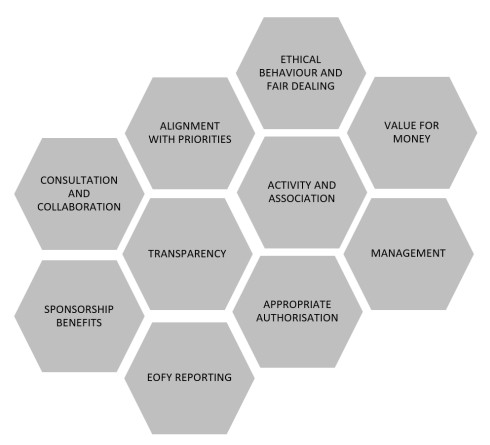
2. SCOPE
Sponsorship is the right to associate the sponsor’s name, products or services with the sponsored organisation’s service, product or activity, in return for negotiated and specific benefits such as cash or in-kind support or promotional opportunities. It involves a negotiated exchange and results in tangible, material and mutual compensation for the principal parties to the arrangement. Sponsorship can take the form of cash and/or in-kind support.
Sponsorship does not include:
- grants or direct funding which may include monies or goods provided to a recipient through a formally recognised program for a specified purpose
- the provision of funds where outcomes for the Board or government cannot be appropriately realised
- endorsements, ex-gratia payments, donations, philanthropic gestures, bequests or gifts, which impose no obligations on the receiver and offer little or no return to the donor
- purchasing or selling goods or services for value, including advertising space, editorial comment or advertorials, and
- sponsorship is not provided to individuals.
The provision of funding to enable employees, contractors, consultants, and board members to attend training courses, personal development opportunities or other such activities is also not considered sponsorship.
3. POLICY STATEMENT
This policy outlines the mandatory sponsorship principles and processes to be followed as part of all sponsorship arrangements. The principles and processes must be complied with by in-scope entities prior to the Board entering into any binding commitment or agreement.
Sponsorship is an effective communication tool available to demonstrate a positive association, showcase new policies and connect with specific audiences.
Where the Board is considering providing funding towards an initiative, consideration must be given to whether the Board can regain benefits for its investment. If a benefit can be derived from the sponsorship investment, it should be considered a sponsorship.
Where there is a shared common goal between both parties, greater support and shared resourcing, the sponsoring party may wish to be acknowledged as a partner of the sponsored initiative. The form of acknowledgment should be documented in the sponsorship agreement. When determining the form of acknowledgment to be provided, Board employees, contractors and consultants, and board members must be aware of the need to avoid making representations that a legal partnership exists between the parties.
Sponsorship proposals must be assessed against, and align with current Board objectives (as defined in the Strategic Plan) and Queensland Government priorities and objectives.
In addition, consideration must be given to the sponsorship initiative’s ability to:
- increase effectiveness of strategic programs
- enhance corporate identity and reputation
- create employment opportunities for Queensland
- observe good social, economic and environmental practice and encourage community engagement
- promote Board initiatives to relevant target audiences
- build and enhance existing relationships at the local, national and international level
- encourage key stakeholders’ participation in important issues and initiatives.
Sponsorships must clearly show:
- transparency
- value for money
- ethical behaviour and fair dealing (abiding by the Public Sector Ethics Act 1994 and the Code of Conduct for the Queensland Public Service).
- appropriate activity and association
- appropriate sponsorship benefits
- appropriate authorisation
- adequate management and reporting.
Additionally, before any sponsorship arrangement is agreed, consideration must be given to whether it will:
- support the Board’s goals and objectives
- increase the effectiveness of strategic programs
- enhance corporate identity and reputation create employment opportunities for Queensland
- observe good social, economic and environmental practice and encourage community engagement
- promote Board initiatives to relevant target audiences
- build and enhance existing relationships at the local, state and national level
- encourage key stakeholders’ participation in important issues and initiatives.
The Board will refer to Queensland Treasury’s Financial Reporting Requirements for Queensland Government Agencies when considering the appropriate accounting treatment for sponsorship arrangements.
Applications must be submitted at least three months before the initiative is held to allow for assessment and approval. This time allows for adequate assessment, approval and leveraging opportunities to be undertaken.
4. TRANSPARENCY AND VALUE FOR MONEY
An open, equitable and efficient approach must be adopted when determining if the activity is deemed a sponsorship, and throughout the ongoing management of the sponsorship.
A business approach must be applied to sponsorship activities to receive value for money. This should not be interpreted as the highest price when receiving sponsorship or the lowest price when providing sponsorship. The level of resources required to service the sponsorship should be considered when entering into any agreement. Considerations should be given to the cost and likely benefits of a request. The effects on the community and economy, both direct and indirect, as well as short- and long-term gains or losses may be able to be assessed.
To ensure value for money is achieved, the Board may consult other relevant agencies to establish if the initiative can offer benefits to other Queensland Government departments and agencies. If this is the case, a cross-agency arrangement maybe taken, with the most relevant agency to be the lead agency for the sponsorship.
7. APPROPRIATE ACTIVITY AND ASSOCIATION
Activities and associations must be appropriate and not seen to diminish the reputation and goodwill of the Board or the Queensland Government. When considering entering into a sponsorship arrangement, the organisation’s financial position, reputation in the community, the involvement they will have in the initiative and the extent to which the organisation’s activities support the Board and Queensland Government priorities must be considered.
The motivations of organisations for entering into sponsorship agreements must be known before an agreement is executed. Motives that may give rise to an inappropriate association include efforts to influence legislation, public policy or the role of the Board.
Any sponsorship must also not compromise the reputation, probity or impinge on the ability of the Board and the Queensland Government. Any potential or actual conflicts of interest must be addressed in the initial assessment process, and due diligence checks can assist with this process. Any sponsorship must be confined to the initiative only and not compromise any another initiative.
It is the responsibility of the Board to consider whether it is appropriate to sponsor:
- fundraising or charity events and activities
- events and activities run for profit
- events and activities run by a private or commercial organisation
- capital works initiatives.
Initiatives deemed high value, high risk, first-of-a-kind or those involving naming rights are referred to the Principal Legal Officer for advice.
When considering sponsorship outcomes, sponsorship agreements should consider the alignment with Board and Queensland Government priority areas. This may include requesting the initiative organiser to:
- ensure diversity in presentations, workshops and panels such as to reflect gender and cultural equity
- where relevant, encourage the use of language, translating and communication services and other considerations to enable accessibility for people with disability and their carers
- where possible, engage with Queensland small and medium sized businesses to deliver the Initiative (including but not limited to suppliers, operational staff, entertainment and performers which are usually based in Queensland)
- source food and beverage grown in, made in, or produced in Queensland, and where possible locally sourced
- implement environmental sustainability practices such as minimising waste and use of single-use plastic products, and efforts to recycle or reuse
- have or implement policies to prevent and intervene in bullying and cyberbullying if the initiative directly engages children or young people.
- not use Board funds for the purchase of alcohol, cigarettes or other controlled substances.
8. APPROPRIATE SPONSORSHIP BENEFITS
Appropriate sponsorship benefits should be negotiated in advance and documented in a sponsorship agreement to ensure the sponsorship delivers value for money. The Board should ensure any opportunity presents appropriate sponsorship entitlements commensurate with the level of sponsorship support. Benefits beyond logo recognition should be considered such as maximising exposure for an initiative or using sponsorship as a platform to shape and define attitudes and behaviour.
9. APPROPRIATE AUTHORISATION AND DELEGATIONS
The Board must ensure written approval is granted to enter into each sponsorship arrangement in line with the current financial delegations by the:
- Communications and Engagement Manager (low risk/low value)
- Registrar (low risk/high value)
- Board Chairperson (high risk/high value).
10. MANAGEMENT, MONITORING, RENEWAL AND EVALUATION
Effective management and reporting processes must be applied to ensure value and accountability.
Sponsorship proposals must be received with sufficient information to allow adequate assessment. If the proposal does not have enough information, the Board must go back to the organisation requesting sponsorship and request additional information.
All sponsorship proposals and agreements will be stored electronically by the Board for 7 years. These documents may be subject to disclosure under the Right to Information Act 2009.
Each sponsorship initiative must be monitored at regular intervals documenting the planning and progress of the sponsorship initiative based on the evaluation criteria set out in the sponsorship agreement. This includes facilitating logo approvals, payment of sponsorship instalments linked to milestones and delivery of sponsorship entitlements.
Each sponsorship must be finalised with either a report prepared for a sponsor, or a final report received by the external organiser. The final report should inform the evaluation and recommendations report.
This evaluation report should focus on key dates, additional leveraging activities, measurement of the objectives set out in the agreement and any recommendations for future decisions.
Renewing sponsorship agreements should be treated with the same rigour as the initial assessment to ensure the agreement still meets current Board and Queensland Government objectives. For recurrent initiatives, consideration should be given as to whether a first right of refusal for future sponsorship be offered and documented in the agreement.
Approval for recurrent initiatives must be sought from the appropriate delegate with the appropriate level of financial delegation. In instances where the agreement is high value or highrisk, or there has been a significant shift in Board or Queensland Government priorities, approval must be sought from the Board.
11. RESPONSIBILITIES AND PROCESS
The Communications and Engagement Manager is the first point of contact for any proposed sponsorship initiatives.
Should employees or Board members be unsure about whether an initiative should be processed as a sponsorship please contact the Communications and Engagement Manager.
The Communications and Engagement Unit is responsible for
- overseeing the Board’s sponsorship activities
- reviewing and assessing sponsorships requests based on set criteria
- submitting suitable opportunities for approval
- ensuring all sponsorship requests (whether approved or not) are captured in the Sponsorship Register
- following approval, formalising sponsorship arrangements and entering into appropriate sponsorship agreements
- liaising with all organisations being sponsored
- managing approved sponsorship activities to ensure maximum benefit is achieved from each opportunity
- maintaining appropriate records
- ensuring final reports are received from all organisations being sponsored
- maintaining the Sponsorship Register and reporting on sponsorship activity to the Board or the Department of the Premier and Cabinet, if required.
Sponsorship proposals are to be considered and approved by any of the following in line with the current financial delegations:
- Communications and Engagement Manager (low risk/low value)
- Registrar (low risk/high value)
- Board Chairperson (high risk/high value).
12. REPORTING REQUIREMENTS
Communications and Engagement Manager must maintain a sponsorship register of all cash and in-kind sponsorships.
This information should be collated throughout the year and reported to the Board on a sixmonthly basis.
Reports will be provided to the Department of the Premier and Cabinet if requested.
13. HUMAN RIGHTS
Decision makers must act and make decisions in a way that is compatible with human rights and give proper consideration to a human right relevant to a decision, as required by s 58 of the Human Rights Act. For further information please refer to the Board’s Human Rights intranet page.
The policy has been reviewed for compatibility with human rights under the Human Rights Act.
The policy has been found to limit human rights only to the extent that is lawful, reasonable, and demonstrably justifiable in accordance with section 13 of the Human Rights Act, therefore, it is reasonable to conclude that the policy is compatible with human rights.
14. APPROVAL
This framework and policy was approved by the Board on 10 December 2025.
ATTACHMENT 1: CONTACT
The Communications and Engagement Manager is the first point of contact for any questions regarding this framework and policy.
ATTACHMENT 2: REFERENCES
The requirements set out in this document are based on, and are consistent with, relevant Government legislation, regulations, directives, information standards and/or policies at the time of publication.
Any reference to legislation, policy or other document is taken to be a reference to that legislation, policy or other document as amended or replaced from time to time.
Financial Accountability Act 2009 (Qld)
Right to Information Act 2009 (Qld)
Public Sector Ethics Act (Qld)
Code of Conduct for the Queensland Public Service
Queensland Government Sponsorship Policy
Financial Reporting Requirements
Queensland Government advertising and communications campaigns (GACC)
Queensland Government Advertising Code of Conduct
Queensland Government corporate identity
Gifts and Benefits Directive and Guideline
Gifts and Benefits Policy
ATTACHMENT 3: DEFINITIONS
Term | Description
|
Donations | Donations are the provision or receipt of cash, property or other assets to a specified “cause” or activity without creating an obligation on the recipient about the use of the resources or providing a reciprocal benefit to the donor |
Ex-gratia payments | Ex-gratia payments should only be made after all possible alternative avenues have been explored. It may be appropriate to obtain legal advice to determine whether a legislative provision is more appropriate than a special payment. Given the nature of special payments (that is, there is no legal obligation to make the payment), it is particularly important to ensure due process is followed. These payments may be subjected to an increased level of public scrutiny and therefore must be publicly defensible |
Grant | Grant is a generic term applied to funding or other incentives provided to individuals or bodies (including community groups, statutory bodies or commercial enterprises) that exhibit some, or all, of the following characteristics:
Grants can be incentives, contributions, debts forgiven, rebates, tax relief and other similar funding arrangements, and may be in the form of cash or other property. However, in recognition of changing levels of demand for increasingly complex service types and emerging service delivery models, government may also consider a variety of more innovative approaches to funding service delivery. Grants must be managed in line with Queensland Treasury’s Financial Accountability Handbook |
In-kind sponsorship or support | Also known as contra sponsorship, in-kind sponsorship or support is the provision or receipt of goods and/or services to support or enhance an initiative at a reduced rate or free of charge. Assuming both parties are registered for GST, and there is a taxable service or product being supplied (not a gift), these arrangements are liable for GST. In-kind sponsorship must offer value to the other party either through benefits or budget relieving. For example, the cost of servicing a sponsorship, or the cost of government staff hosting a government stand should not be seen as in-kind sponsorship |
Leveraging | Leveraging activities may including profiling an aligned program alongside the initiative and may require additional budget. Leveraging activities by a sponsor can raise the return on sponsorship investment. For example, if an initiative can provide an opportunity to closely interact with a specific target market, you may choose to create a digital piece specifically for that audience which would come at a cost. A typical industry leveraging budget may be between 10 to 25 per cent of the sponsorship cost |
Outgoing sponsorship | Outgoing sponsorship is when the Board provides sponsorship to another party for an initiative |
Partnership | A legal partnership occurs where two or more people carry on a business jointly with a view for profit. Generally, a partnership is not itself a separate legal entity, rather it is the individual partners comprising the partnership who will be the parties to the sponsorship agreement. Therefore, each individual partner’s name must be included as the organisation. The Partnership Act 1891(Qld) provides for incorporated partnerships. These partnerships should be referenced in the sponsorship agreement by the name used to describe the legal entity. You should gather as much information on the partnership as possible, including copies of any partnership agreement, and refer this information to your departmental legal officers for advice before entering into a sponsorship agreement |
Queensland Government Sponsorship Framework | The Queensland Government Sponsorship Framework includes the Queensland Government Sponsorship Policy, Guidelines for Outgoing Sponsorship, Guidelines for Incoming Sponsorship and associated templates. All Queensland Government departments, agencies and bodies that use the Queensland Government Coat of Arms on their communication materials and website must abide by the Queensland Government Sponsorship Framework. The Framework is strongly recommended to those statutory bodies including statutory authorities and government-owned corporations that retain an identity fully independent of the Queensland Government corporate identity |
Sponsorship | Sponsorship is the right to associate the sponsor’s name, products or services with the sponsored organisation’s service, product or activity, in return for negotiated and specific benefits such as cash or in-kind support or promotional opportunities. It involves a negotiated exchange and results in tangible, material and mutual compensation for the principal parties to the arrangement. Sponsorship can take the form of cash and/or in-kind support. Sponsorship does not include: * grants or direct funding which may include monies or goods provided to a recipient through a formally recognised program for a specified purpose |