 Contact us
 RPEQ sign in
 RPEQ directory

Sponsorship guidelines
On this page
1. PURPOSE
These guidelines support Board employees, consultants and contractors, and Board members to enter into and provide appropriate sponsorship arrangements while complying with the Board Sponsorship Framework and Policy.
This framework and policy applies to all Board members and employees working for the Board (both Board appointed employees and public servants) regardless of whether they are permanent, fixed term temporary, full-time, part-time, or casual employees and/or on secondment from another department. It also applies to other persons who perform work for the Board including contractors, students gaining work experience and volunteers. For the purposes of this policy, the term contractor includes on-hired temporary labour services (agency staff).
The Board Sponsorship Framework and associated documents relates to the management of sponsorship for external events and initiatives (outgoing sponsorship).
2. CORE SPONSORSHIP PRINCIPLES
Sponsorship is the right to associate the sponsor’s name, products or services with the sponsored organisation’s service, product or activity, in return for negotiated and specific benefits such as cash or in-kind support or promotional opportunities. It involves a negotiated exchange and results in tangible, material and mutual compensation for the principal parties to the arrangement. Sponsorship can take the form of cash and/or in-kind support.
Sponsorship does not include:
- grants or direct funding which may include monies or goods provided to a recipient through a formally recognised program for a specified purpose
- the provision of funds where outcomes for the Board or government cannot be appropriately realised
- endorsements, ex-gratia payments, donations, philanthropic gestures, bequests or gifts, which impose no obligations on the receiver and offer little or no return to the donor
- purchasing or selling goods or services for value, including advertising space, editorial comment or advertorials.
Sponsorship is not provided to individuals. The provision of funding to enable employees, contractors, consultants, and board members to attend training courses, personal development opportunities or other such activities is also not considered sponsorship.
The Guidelines aligns to the key principles of the Queensland Government Sponsorship Policy and its principles:
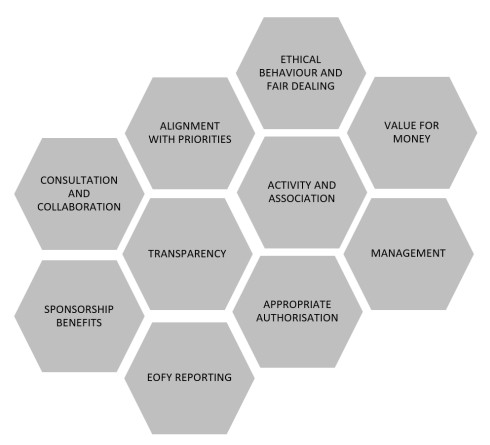
Care should be taken before entering into a sponsorship agreement with any or organisation that is:
- tendering for, or likely to tender for, future significant Board contracts, to avoid perceptions of bias
- a friend, relative or business associate. In such cases, a conflict of interest must be declared in accordance with the Conflict of Interest policy and discussed with Board management.
3. ALIGNMENT AND ASSESSMENT OF SPONSORSHIP REQUESTS
All outgoing sponsorship requests to the Board are assessed and rated against the following criteria:
- how well the event/project targets Board stakeholders and audiences
- range of expected tangible benefits to be received
- relevance of activity to core business of the Board and alignment to key priorities
- reputation of the organisation seeking sponsorship
- conflict with other supporting activities
- costs involved
- extent to which sponsorship performance and suggested benefits can be assessed
- value for money.
In addressing the criteria, applicants must disclose all matters that would affect the Board’s consideration of their sponsorship request.
The Board reserves the right and capacity to undertake reasonable checks of applicants at its discretion. Such checks may include referee checks and/or financial/probity checks of the applicant and the organisation associated with the applicant.
Should the Board approve an applicant and then later become aware of matters that would disqualify that organisation from receiving sponsorship, approval for sponsorship may be withdrawn. The Board will not accept responsibility for any loss or damage suffered as a result.
4. WHO CAN APPLY FOR SPONSORSHIP?
Legal entities such as incorporated associations, local government and companies can apply for sponsorship. Individuals cannot apply.
The Board encourages sponsorships that can build and strengthen the relationship between the Board and stakeholder groups and associated/affiliated organisations.
An organisation that has previously received sponsorship from the Board but has not provided a final report will not be considered for repeat sponsorship.
Types of activities considered for sponsorship:
- conferences
- forums
- seminars
- events.
Types of activities NOT considered for sponsorship
- funding of individuals
- events where surplus funds are raised specifically to be donated to charity
- private or commercial activities
- capital equipment or works
- funding of research, trials or feasibility studies
- award ceremonies
- events with a sole aim to raise funds for charity via means such as entry or site fees will not be considered.
- events that allow charities to fundraise at their venue (e.g. charity staff run a sausage sizzle or sell merchandise) may be considered for funding.
In addition, the following are also ineligible for sponsorship:
- Projects or events that are not consistent with the Board’s vision, purpose and key messages
- Projects or events that conflict with, or are similar to existing Queensland Government sponsorships
- Any project or event that entails high-risk activities or poor occupational health and safety performance.
5. BOARD BENEFITS
In return for the investment, the Board must receive tangible benefits that provide value for money.
Appropriate acknowledgment of the Board’s support is mandatory. Benefits preferred by the Board could be either high value or low value.
high value:
- speaking or presenting opportunities to a targeted audience
- opportunities to communicate a relevant message
- opportunities to promote new initiatives/projects
- opportunities to network with targeted audience
low value:
- speaking at very large outdoor events
- print publications
- social media mentions
- signage in presentations and event halls.
6. SPONSORSHIP OBLIGATIONS
Applications must be submitted at least three months before the initiative is held to allow for assessment and approval. This time allows for adequate assessment, approval and leveraging opportunities to be undertaken.
All approved sponsorships and agreed benefits will be supported by a signed formal agreement. Where the requirements for a sponsorship cannot be met (supported by signed agreements, or associated accountability and evaluation requirements) financial support will not be provided.
Recipients are required to provide a final report within two months of completion of the sponsored event or project. Failure to provide a report will be considered a breach of the agreement and will disqualify the recipient organisation from future sponsorship.
The Board’s decisions are final, and binding and the Board will be the final arbitrator of funding decisions under its sponsorship program.
Applicants will be notified of the success or otherwise of their application in writing.
The Board may elect to, but shall be under no obligation to, give reasons for not accepting any application.
7. CONTACT
The Communications and Engagement Manager is the first point of contact for any proposed sponsorship initiatives.
8. APPROVAL
These guidelines were approved by the Board on 10 December 2025.